Case 03Operational experienceCore case
Material Master, BOM and SPIL Data Quality
Business questionCan this material be identified, purchased and connected to the correct equipment with confidence?
Equipment-to-spare linkage through technical descriptions, manufacturer and part number, UoM, BOM, cataloguing and project handover controls.
Actual professional work, operational responsibility or implemented activity.
Why it matters
- Data integrityOne reliable record per material.
- AvailabilitySpares can be found through the failing equipment.
- Procurement riskSuppliers quote against a precise, complete description.
- Maintenance readinessNew equipment is handed over with its spare-parts structure.
01Business context
Every maintenance and supply decision depends on the material record. Planners search for it, buyers send it to suppliers, the warehouse receives against it and engineers link it to the equipment it serves.
When the description is vague, the manufacturer and part number are missing, the unit of measure is wrong or the material is not linked to the equipment BOM, each of those users works around the gap. The result is duplicate materials, wrong parts, rejected deliveries and spares nobody can find when the equipment fails.
New projects add their own risk: equipment arrives with spare-parts lists (SPIL) that must become catalogued materials and BOMs before handover, or the plant inherits equipment without a reliable spare-parts structure.
02My role
My responsibility
Maintained and quality-checked equipment, plant-location, PM, job-plan and spare-parts data and linked materials to equipment as CMMS Mechanical Engineer. Later covered SPIL and cataloguing as Spare Parts Superintendent, and master data as Field Materials Superintendent.
Wider process
Engineering and OEM documentation define the technical data. Projects deliver equipment and spare-parts lists. Cataloguing and master-data teams create and maintain the records. Maintenance planning uses the BOM in work orders.
03Signals and inputs
The information that drives the decision.
- S01EquipmentTag, model and plant location.
- S02BOMThe structure that links equipment to its spares.
- S03Material numberOne record per unique item.
- S04DescriptionStandardised technical description.
- S05ManufacturerOriginal manufacturer of the item.
- S06Part numberManufacturer part number, complete and exact.
- S07Unit of measureThe unit in which the item is bought, stored and issued.
- S08Technical documentationDatasheets, drawings and OEM manuals.
- S09SPILSpare-parts list delivered with project equipment.
04Data chain
Can this material be identified, purchased and connected to the correct equipment with confidence?
- Check
- Gate: can trigger escalation
Open a step to see why it matters and when it is escalated.
01Gate
Equipment
Tag, model, location and criticality.
Why it matters and when to escalate
- Why it matters
- Spares only make sense in relation to the equipment they serve.
- Escalate when
- Equipment exists in the plant but not in the CMMS.
02Gate
BOM
Spare-parts structure linked to the equipment.
Why it matters and when to escalate
- Why it matters
- Planners and engineers find spares through the BOM.
- Escalate when
- Critical equipment has no BOM.
03Gate
Material
Existing material number or a new record.
Why it matters and when to escalate
- Why it matters
- Duplicates split stock and demand across two records.
- Escalate when
- A possible duplicate is found.
04
Description
Standardised and technically sufficient.
Why it matters
- Why it matters
- A vague description invites the wrong part.
05
Manufacturer
Original manufacturer recorded.
Why it matters
- Why it matters
- Equivalents can only be judged against the original.
06Gate
Part number
Complete, exact manufacturer part number.
Why it matters and when to escalate
- Why it matters
- The part number is how suppliers identify the item.
- Escalate when
- The part number is incomplete or conflicting.
07Gate
UoM
Unit of purchase, storage and issue.
Why it matters and when to escalate
- Why it matters
- A wrong unit multiplies or divides every quantity.
- Escalate when
- Units differ between documents.
08
Technical documentation
Datasheets, drawings and OEM references.
Why it matters
- Why it matters
- Evaluation and acceptance need the source documents.
05Illustrative scenario
Built to show the reasoning. Not a record of a specific company transaction, tender or supplier.
A spare part identified from OEM documentation
01Equipment
A spare part is identified in the OEM documentation of installed equipment.
02Manufacturer
Confirm the original manufacturer, not only the distributor.
03Part number
Confirm the full manufacturer part number, character by character.
04Technical attributes
Confirm the description and the unit of measure (UoM).
05Duplicate search
Search the Material Master by manufacturer, part number and description.
06Material record
Existing material found
Reuse it; no new record is created.
Near duplicate found
Clarify and correct the record before use; do not create a second one.
No valid record
Create one record from the confirmed data.
07Equipment BOM
Link the approved material to the correct equipment BOM.
06Professional judgement
Data quality is operational integrity.
A material master record is not an administrative entry. It decides whether the right part is bought, received, found and installed. A wrong unit of measure or a missing BOM link looks small in a database and becomes very visible on the day the equipment fails.
The judgement is in deciding what is good enough. A record does not need every possible attribute, but it needs the ones that let a planner, a buyer and a storekeeper identify the same item without guessing.
07What can go wrong
Wrong description
Suppliers quote and deliver a different item.
ControlStandardised descriptions with technical attributes.
Duplicate material
Stock sits under one number while another is purchased.
ControlCheck for duplicates before creating a record.
Wrong UoM
Quantities are wrong by a factor.
ControlConfirm units against OEM and supplier documents.
Missing equipment link
The spare exists but is not found for the failure.
ControlLink materials to equipment BOMs.
Incomplete manufacturer or part number
Identification and equivalence become guesswork.
ControlRecord the manufacturer and the full part number.
Weak BOM at project handover
New equipment arrives without a usable spares structure.
ControlTurn SPIL into catalogued materials and BOMs before handover.
08Decision outcomes
- LinkMaterial connected to the correct equipment BOM.
- CreateNew record created once no duplicate exists.
- CorrectDescription, part number or UoM corrected.
- Block duplicateDuplicate record blocked, demand consolidated.
- ClarifyData requested from engineering, the OEM or the project.
09Value created
- Fewer duplicatesStock and demand are visible under one record.
- Right part first timeSuppliers and storekeepers work from precise data.
- Faster maintenance planningSpares are found through the equipment.
- Clean handoverProject equipment arrives with a spare-parts structure.
10Evidence and basis
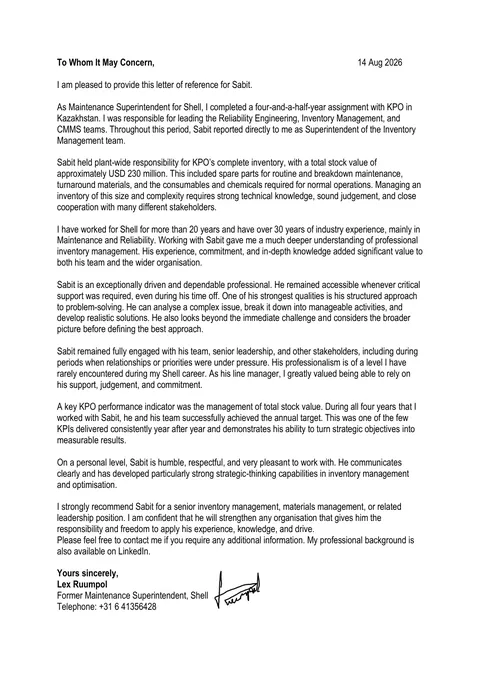
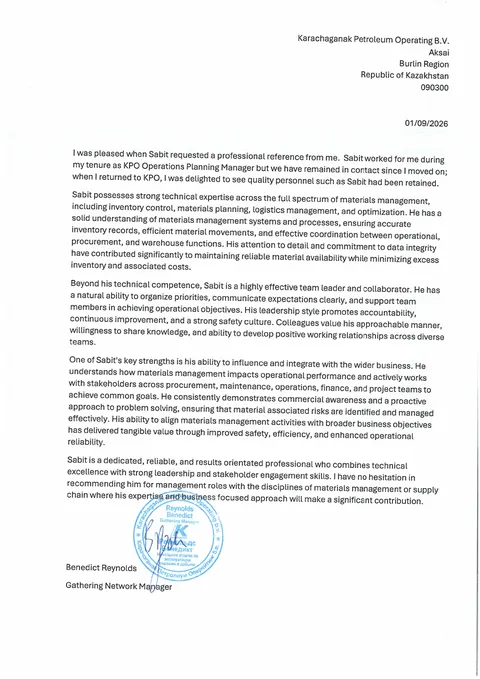
BOMs developed and implemented for all equipment identified during new projects, including OEM part numbers, material coding and reorder levels; described in the letter as achieved with Sabit's significant contribution.
SourceReference letter, Claudio Damanti, former line manager at KPO (2017 to 2023)
Basis of this case
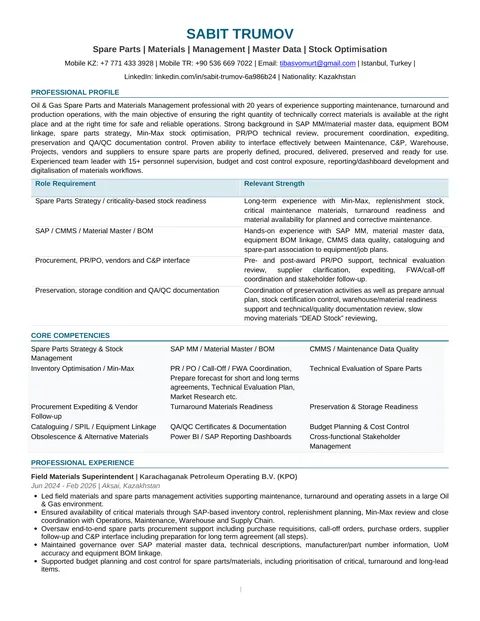
CV: CMMS Mechanical Engineer (2006 to 2008), equipment and spare-parts data and material-to-equipment linkage; SPIL and cataloguing (Spare Parts Superintendent); master data (Field Materials Superintendent). The failure examples are conceptual, not records from a company system.
Connected intelligence
Where this case connects to the career, the Knowledge Book and the credentials.