Case 02Framework developedCore case
Technical Evaluation Governance
Business questionIs the supplier offer technically acceptable, evidenced and ready for recommendation?
Supplier offers, certificates, technical clarifications and final recommendations in one controlled, auditable evaluation workflow: decision gates, bidder evidence, certificates, clarification and approval.
A process, methodology, guideline or governance framework developed from professional knowledge.
Why it matters
- Technical complianceRecommend only offers that meet the requirement.
- Procurement riskAvoid awards based on incomplete or unverified offers.
- TraceabilityLink every outcome to the requirement and the evidence.
- Lifecycle riskWeigh reliability and support, not only unit price.
01Business context
When a requirement goes to market, suppliers answer with offers that differ in what they quote, how they describe it and what they can prove. Some quote an equivalent instead of the requested part, some leave lines unquoted, some attach incomplete certificates.
The technical evaluation decides which offers can be recommended. If that decision lives only in an email thread or in one engineer's memory, it cannot be checked later: by procurement, by approvers, or by an auditor asking why an offer was rejected.
The framework treats every acceptance and rejection as a traceable decision: linked to the requirement, supported by bidder evidence, with open clarifications closed before the recommendation goes for approval.
02My role
My contribution
Prepared technical evaluations as Spare Parts Engineer and reviewed technical evaluations as Spare Parts Superintendent. From that work I developed a governance approach for evaluations: decision gates, bidder evidence, certificate checks, clarification and approval traceability.
Wider process
The requirement comes from maintenance and engineering. Procurement (C&P) runs the tender and the commercial evaluation and owns the award. Approvers sign off the recommendation. The framework covers the technical part of that chain and how it is documented.
03Signals and inputs
The information that drives the decision.
- S01Technical requirementSpecification, part number and the equipment it serves.
- S02Supplier offerWhat was quoted, line by line, and in what form.
- S03Quoted / not quotedLines the bidder did not offer.
- S04Manufacturer and part numberOriginal, equivalent or alternative item.
- S05CompatibilityFit, form and function with the installed equipment.
- S06CertificatesRequired documents and their status.
- S07Technical clarificationQuestions raised and answers received.
- S08Compliance concernsIssues such as sanctions concerns that need a separate control.
04Decision path
Is the supplier offer technically acceptable, evidenced and ready for recommendation?
- Check
- Gate: can trigger escalation
- Decision
Open a step to see why it matters and when it is escalated.
01Gate
Requirement
Specification, quantity and equipment reference.
Why it matters and when to escalate
- Why it matters
- Every later decision is measured against it.
- Escalate when
- The requirement itself is ambiguous.
02
Supplier offer
Offered item, manufacturer and part number per line.
Why it matters
- Why it matters
- An offer can look complete and still quote something else.
03Gate
Quoted / not quoted
Lines without a quotation.
Why it matters and when to escalate
- Why it matters
- A missing line is a different outcome from a non-compliant one.
- Escalate when
- Critical lines are not quoted by any bidder.
04Gate
Technical compliance
Specification, compatibility and equivalence.
Why it matters and when to escalate
- Why it matters
- An equivalent is acceptable only when it is shown to be equivalent.
- Escalate when
- Equivalence cannot be confirmed from the offer.
05Gate
Certificates
Required certificates present and valid.
Why it matters and when to escalate
- Why it matters
- Material without the required documents may not be usable.
- Escalate when
- Required certificates are missing or inconsistent.
06Gate
Technical clarification
Open questions to the bidder and their answers.
Why it matters and when to escalate
- Why it matters
- An open question is not a basis for a recommendation.
- Escalate when
- A clarification stays open past the evaluation deadline.
07
Evidence
Each acceptance or rejection linked to a document.
Why it matters
- Why it matters
- The decision has to survive review by someone else.
08
Recommendation
Technically acceptable offers, with reasons.
Why it matters
- Why it matters
- Procurement receives a decision it can act on.
09Decision
Approval
Sign-off of the technical recommendation.
Why it matters
- Why it matters
- Ownership of the technical decision is recorded.
05Illustrative scenario
Built to show the reasoning. Not a record of a specific company transaction, tender or supplier.
One spare part, two offers
01Requirement
A spare part with a specified manufacturer part number. A material certificate must be submitted with the offer.
02Bidder evidence
Bidder A
Offers the requested part number; the certificate is submitted.
Bidder B
Offers an alternative as an equivalent; the certificate is incomplete and equivalence is not demonstrated.
03Compliance check
Bidder A
Part number, specification and certificate match the requirement.
Bidder B
Fit, form and function cannot be confirmed from the offer; the certificate does not cover the requirement.
04Clarification
Bidder A
No open questions.
Bidder B
Ask for equivalence evidence (datasheet, dimensions, materials) and the complete certificate.
05Technical decision
Bidder A
Technically acceptable.
Bidder B
Clarification required: not recommended until equivalence and certification are shown.
06Professional judgement
A technically compliant offer is not automatically the lowest-risk lifecycle decision.
Two offers can both meet the specification and still differ in reliability, support, delivery and compatibility with what is already installed. The evaluation should make those differences visible instead of reducing them to compliant or non-compliant.
The purpose of technical evaluation is not only to select a bidder. It is to preserve engineering judgement, so the decision remains understandable and auditable later.
07What can go wrong
Unquoted line treated as compliant
A required item is missing from the award.
ControlMark quoted and not quoted line by line.
Equivalent accepted without proof
A wrong or incompatible part reaches the plant.
ControlRequire evidence of equivalence.
Certificate gap found late
Material arrives but cannot be accepted.
ControlCheck certificates during evaluation, not at receipt.
Clarification not closed
The recommendation rests on an assumption.
ControlNo recommendation while questions stay open.
Decision without a reason
A rejection cannot be defended later.
ControlRecord reason and evidence for each outcome.
Price-only comparison
Lifecycle cost and risk are ignored.
ControlConsider total cost of ownership where offers differ.
08Decision outcomes
- AcceptTechnically acceptable, evidenced and recommended.
- ClarifyAcceptable in principle; open questions must be closed first.
- RejectDoes not meet the requirement; reason and evidence recorded.
- HoldDecision waits for documents or an engineering opinion.
09Framework objective
- Traceable recommendationsEach outcome is linked to requirement and evidence.
- Fewer surprises at receiptCertificate and equivalence gaps surface before the award.
- Defensible decisionsAcceptances and rejections survive audit and review.
- A shared standardEvery offer passes the same gates.
10Evidence and basis
Basis of this case
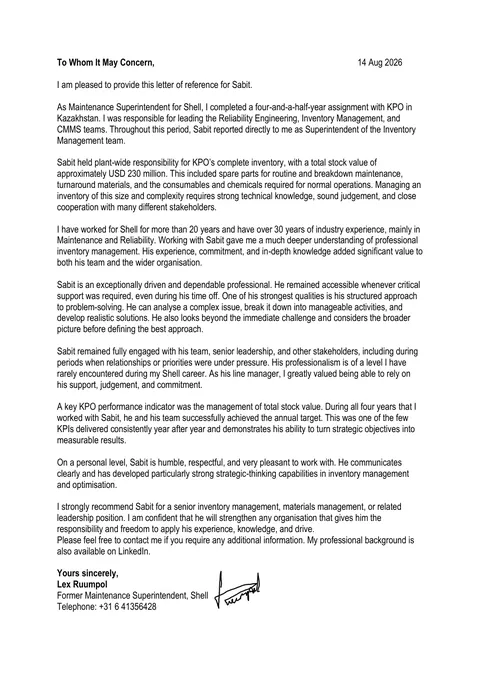
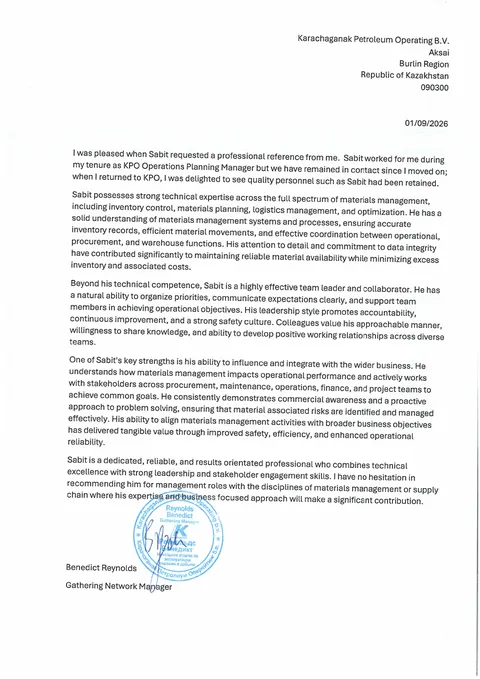
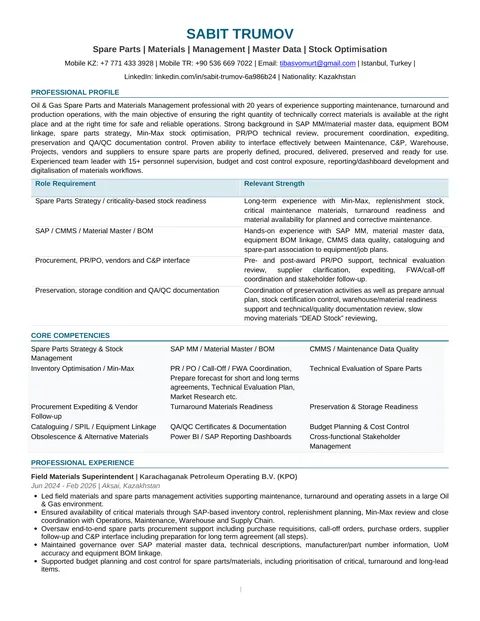
CV: technical evaluations (Spare Parts Engineer, 2008 to 2011) and technical-evaluation review (Spare Parts Superintendent, 2012 to 2024). The decision chain is described in the Knowledge Book article Technical Evaluation Decision Chain. Presented as a framework developed from that work, not as a company procedure.
Connected intelligence
Where this case connects to the career, the Knowledge Book and the credentials.