Case 01Operational experienceCore case
Demand Review and Excess Prevention
Business questionDo we really need to buy this material?
Compare warehouse balance, reservations, open PR and PO supply, Min-Max and transfer opportunities before approving new purchase demand. The purchase is the last option, not the first.
Actual professional work, operational responsibility or implemented activity.
Why it matters
- Working capitalAvoid buying what stock or open supply already covers.
- AvailabilityProtect genuine maintenance demand, above all for critical spares.
- TraceabilityMake every purchase, reduction or transfer explainable afterwards.
- AccountabilityKeep the decision with a named owner, not with the system default.
01Business context
Maintenance demand reaches the warehouse as work-order requirements, reservations and purchase requisitions. Each one is a signal. None of them, on its own, proves that new stock must be bought.
The same material can already be on hand, reserved for another job, on order through an open PO or call-off (CON), held at another storage location, or covered by the Min-Max replenishment logic. When these signals are read separately, the plant pays twice: once for a purchase it did not need, and again for carrying the excess.
The opposite error is just as costly. If a genuine maintenance requirement is reduced or delayed without understanding criticality, a simple repair can turn into extended downtime. Demand review exists to tell these two situations apart.
02My role
My responsibility
Reviewed requisitions against stock, reservations and open supply, set Min-Max levels and monitored usage and stock movement as Spare Parts Engineer. As Spare Parts Superintendent and later Field Materials Superintendent, governed replenishment stock, Min-Max and inventory decisions for maintenance, turnaround and operating assets.
Wider process
Maintenance planning creates the demand and confirms the work. Procurement (C&P) owns the commercial cycle once a requisition is approved. The warehouse holds the physical balance. The review sits between them and decides whether a requirement should become a purchase at all.
03Signals and inputs
The information that drives the decision.
- S01Work-order demandThe maintenance requirement and the date it is needed.
- S02Warehouse balanceUnrestricted stock already on hand.
- S03ReservationsQuantity already committed to other work orders.
- S04Open PRRequisitions raised but not yet ordered.
- S05Open PO / CONSupply already ordered, including call-offs.
- S06Min-MaxThe replenishment band set for the material.
- S07Other storage locationsFree stock that could be transferred instead of bought.
- S08CriticalityThe consequence of the material not being available.
- S09Consumption historyWhether the demand matches actual usage.
- S10Lead timeHow early the decision has to be made.
04Decision path
Do we really need to buy this material?
- Check
- Gate: can trigger escalation
- Decision
Open a step to see why it matters and when it is escalated.
01Gate
Demand
Work order, quantity and need date behind the requirement.
Why it matters and when to escalate
- Why it matters
- A requirement without a confirmed job or date cannot be prioritised.
- Escalate when
- The requirement has no traceable work order or need date.
02
Warehouse balance
Unrestricted stock at the requesting plant.
Why it matters
- Why it matters
- Stock on hand may cover the demand without any purchase.
03Gate
Reservations
Quantity already committed to other work orders.
Why it matters and when to escalate
- Why it matters
- Free stock is the balance minus what is already promised.
- Escalate when
- Reservations look outdated or exceed the balance.
04Gate
Open PR
Requisitions already raised for the same material.
Why it matters and when to escalate
- Why it matters
- Duplicate requisitions are a common source of excess.
- Escalate when
- Several open requisitions exist for the same need.
05Gate
Open PO / CON
Supply already ordered, including call-offs under agreements.
Why it matters and when to escalate
- Why it matters
- Ordered quantity will arrive and counts as supply.
- Escalate when
- Open supply is late for the need date.
06Gate
Min-Max
Projected stock against the maximum level.
Why it matters and when to escalate
- Why it matters
- Quantity above the maximum is potential excess.
- Escalate when
- A suggested decrease affects a critical or long-lead item.
07Gate
Transfer opportunity
Free stock at other storage locations.
Why it matters and when to escalate
- Why it matters
- A controlled transfer can be faster and cheaper than a purchase.
- Escalate when
- Ownership or availability of the source stock is unclear.
08Gate
Criticality and context
Failure consequence, lead time and planned maintenance.
Why it matters and when to escalate
- Why it matters
- Low consumption does not mean low importance.
- Escalate when
- A reduction would create an availability risk.
09Decision
Controlled demand decision
Proceed, reduce, transfer, clarify, hold, escalate or cancel.
Why it matters
- Why it matters
- The decision carries a reason another person can follow.
Formula
(Warehouse balance + PR + PO/CON − Reserved) − Maximum stock = Suggested decrease
Example(4 + 0 + 17 − 7) − 10 = 4 EA
A suggested decrease of 4 EA means the open supply would leave 4 EA above the maximum. The result is a decision signal, not an automatic cancellation: criticality, future maintenance demand, alternative stock and transfer opportunities are still checked before the quantity changes.
05Illustrative scenario
Built to show the reasoning. Not a record of a specific company transaction, tender or supplier.
Open supply above the maximum level
01Input
Warehouse balance 4 EA · Open PR 0 · Open PO / CON 17 EA · Reserved 7 EA · Maximum 10 EA
02Calculation
(4 + 0 + 17 − 7) − 10 = 4 EA
03System signal
Projected stock would sit 4 EA above the maximum: a suggested decrease of 4 EA.
04Professional check
Criticality · future maintenance demand · lead time · alternative stock · transfer opportunity
05Decision
Excess confirmed
Reduce the open supply by 4 EA and record the reason.
Real need confirmed
Keep the quantity, for example for planned maintenance or a long-lead critical item, and record why the signal was not applied.
Needed at another location
Transfer the surplus under control instead of cancelling supply.
06Professional judgement
A system signal should not automatically become a purchasing decision.
SAP shows balances, reservations and open documents, but it does not know that a reservation belongs to a cancelled job, that a call-off is already late, or that a low-consumption item protects critical equipment. The professional work is reading the signals together and deciding which of them the plant should trust.
Purchase is the last controlled option, after existing supply and available stock have been understood. Reducing demand is not the goal in itself. The goal is to buy what maintenance genuinely needs, once.
07What can go wrong
Duplicate demand
The same need is purchased twice through separate requisitions.
ControlCheck open PR and PO/CON before approval.
Open supply ignored
Stock arrives above the maximum and becomes excess.
ControlCount ordered quantity as supply.
Outdated reservations
Free stock looks smaller than it really is.
ControlChallenge reservations without an active job.
Formula applied blindly
A critical spare is reduced below a safe level.
ControlReview criticality and lead time before reducing.
Uncontrolled transfer
Stock moves but ownership and balances no longer match.
ControlConfirm source availability and ownership first.
Urgency without justification
Routine demand bypasses the review.
ControlAsk for the work order and need date.
08Decision outcomes
- ProceedDemand confirmed and not covered by stock or open supply.
- ReducePart of the quantity is already covered; buy only the balance.
- TransferFree stock exists at another location; move it under control.
- ClarifyQuantity, date or work order needs confirmation.
- HoldThe need is real but not yet due; keep it visible without ordering.
- EscalateCriticality or risk needs a management or engineering decision.
- CancelThe requirement is fully covered or no longer valid.
09Value created
- Avoided purchasingStock and open supply are used before new money is committed.
- Protected availabilityCritical and long-lead demand is not cut by a formula.
- Traceable decisionsEach reduction, transfer or purchase has a recorded reason.
- Visible ownershipRequester, reviewer and approver know who decided what.
10Evidence and basis
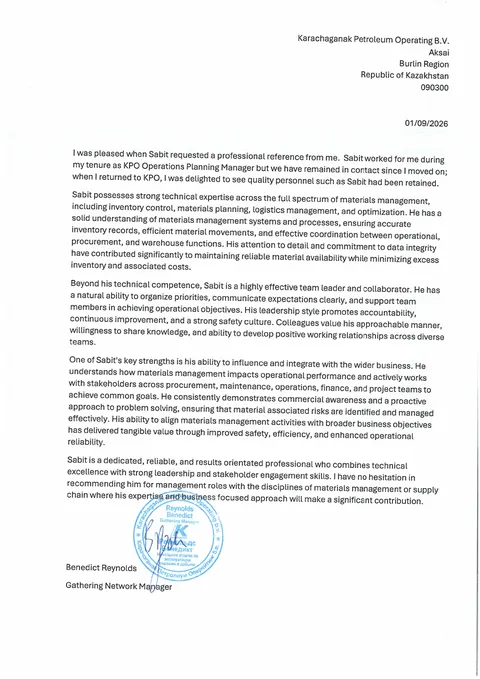
Inventory value reduced by more than USD 23 million, a milestone the letter describes as achieved with Sabit's significant contribution.
SourceReference letter, Claudio Damanti, former line manager at KPO (2017 to 2023)
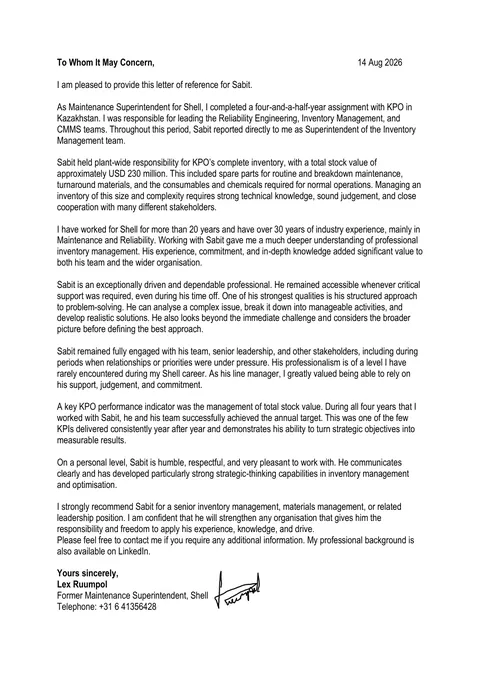
Annual total-stock-value target achieved in each of four consecutive years (paraphrased).
SourceReference letter, Lex Ruumpol, former Maintenance Superintendent (Shell)
Basis of this case
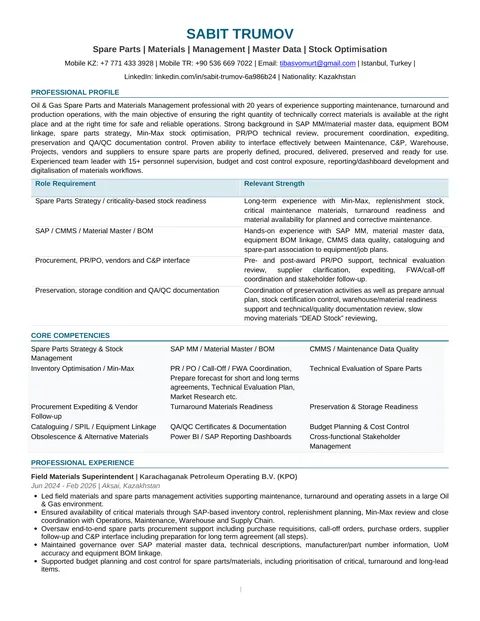
CV: requisition and stock review and Min-Max setting (Spare Parts Engineer, 2008 to 2011); replenishment stock and Min-Max (Spare Parts Superintendent, 2012 to 2024); inventory and replenishment (Field Materials Superintendent, 2024 to 2026). Formula and example from the Knowledge Book article Excess Prevention Before Purchase. The reference-letter outcomes describe the wider inventory responsibility and are not attributed to this case alone.
Connected intelligence
Where this case connects to the career, the Knowledge Book and the credentials.