Case 05Operational experience
Procurement, Expediting and Agreement Support
Business questionHow do we keep material demand commercially controlled and operationally visible through the supply cycle?
PR, PO, call-off and FWA requirements, long-term forecasts, technical inputs, supplier follow-up and delivery-risk escalation.
Actual professional work, operational responsibility or implemented activity.
Why it matters
- Delivery riskLate supply is seen while there is still time to act.
- Material readinessOrdered material arrives in time for the planned work.
- GovernanceRequirements and technical inputs are complete before commitment.
- Working capitalAgreement volumes follow realistic forecasts.
01Business context
Between a maintenance requirement and a usable spare on the shelf, the material passes through several hands: requisition, technical input, the commercial process, the order or call-off, supplier production and delivery.
Commercial ownership of that cycle sits with procurement (C&P). The materials role works alongside it: making sure the requirement is right, the technical input is complete, agreement volumes are forecast realistically and delivery risk is seen early enough to act.
When that interface is weak, orders go out against unclear requirements, framework agreements are sized on guesses, and maintenance learns about a late delivery on the day the job starts.
02My role
My responsibility
Supported order placement as Spare Parts Engineer and procurement as Field Materials Superintendent: PR, PO, call-off and Framework Agreement (FWA) requirements, long-term forecasts, technical inputs, supplier follow-up, expediting, issue resolution and coordination with C&P.
Wider process
Procurement (C&P) owns tendering, negotiation, contracts, orders and the commercial relationship with suppliers. Suppliers own production and delivery. Maintenance owns the work plan. This case covers materials and technical support at each interface, not commercial procurement ownership.
03Signals and inputs
The information that drives the decision.
- S01RequirementWhat is needed, for which work and by when.
- S02ForecastExpected demand for agreement materials.
- S03PRThe purchase requisition and its technical content.
- S04Technical inputSpecification, evaluation and clarification.
- S05PO / call-off / FWAThe commercial instrument used to buy.
- S06Supplier confirmationConfirmed quantity and delivery date.
- S07Delivery statusProgress against the need date.
- S08Need dateWhen maintenance or the turnaround requires the material.
04Supply timeline
How do we keep material demand commercially controlled and operationally visible through the supply cycle?
- Check
- Gate: can trigger escalation
- Decision
Open a step to see why it matters and when it is escalated.
Maintenance / Materials
01Gate
Requirement
Quantity, need date and work reference.
Why it matters and when to escalate
- Why it matters
- Commercial work starts from a correct requirement.
- Escalate when
- The need date is unrealistic for the lead time.
Materials
02Gate
Forecast
Expected demand for agreement materials.
Why it matters and when to escalate
- Why it matters
- Framework agreements are sized from forecasts.
- Escalate when
- Forecast and actual call-offs diverge.
Materials
03
PR
Requisition content and approvals.
Why it matters
- Why it matters
- The PR carries the requirement into procurement.
Materials
04Gate
Technical input
Specification, evaluation and clarification.
Why it matters and when to escalate
- Why it matters
- Buyers and suppliers need a complete technical basis.
- Escalate when
- Technical questions block the commercial process.
C&P
05
PO / call-off / FWA
Order placed or call-off issued under an agreement.
Why it matters
- Why it matters
- Commercial commitment and ownership move to C&P.
C&P / Materials
06Gate
Supplier follow-up
Confirmation, production and shipping status.
Why it matters and when to escalate
- Why it matters
- A confirmed date is not yet a delivered item.
- Escalate when
- Confirmation is missing or the date moves.
Materials
07Gate
Delivery risk
Expected arrival against the need date.
Why it matters and when to escalate
- Why it matters
- Late supply affects planned maintenance.
- Escalate when
- Arrival falls after the need date.
C&P / Maintenance
08
Escalation
Expedite, alternative source, transfer or re-plan.
Why it matters
- Why it matters
- Escalation turns a known risk into a decision.
Materials
09Decision
Material readiness
Received, accepted and available for the work.
Why it matters
- Why it matters
- The supply cycle ends when the material can be used.
05Professional judgement
Expediting is not chasing suppliers. It is deciding which delays matter.
Not every late delivery threatens the plant. The judgement is in connecting supply status to the work plan: a delay on a stock item may be irrelevant, while a few days on a turnaround spare decide whether the job starts on time.
The same applies to agreements. A framework agreement is only as useful as the forecast behind it, so the materials input has to be realistic rather than generous.
06What can go wrong
Unclear requirement
The supplier delivers what was written, not what was needed.
ControlComplete requirement and technical input before ordering.
Forecast based on guesswork
Agreement volumes miss real demand.
ControlBase forecasts on consumption and planned work.
Silent delay
Maintenance learns about the delay at the job.
ControlFollow up confirmations against need dates.
Late escalation
No time is left for alternatives.
ControlEscalate as soon as arrival moves past the need date.
Unclear follow-up ownership
Materials and C&P each assume the other is acting.
ControlAgree who follows up which item.
07Decision outcomes
- On trackSupply confirmed in time for the need date.
- ExpediteDelivery accelerated with the supplier through C&P.
- Re-planWork date adjusted with maintenance.
- AlternativeTransfer or alternative source considered.
- EscalateManagement decision on cost, time or risk.
08Operational value
- Earlier risk visibilityDelays are seen while options remain.
- Better agreement sizingForecasts support framework agreements.
- A complete technical basisFewer clarifications during the commercial process.
- Clear interfacesMaterials and C&P know who acts on what.
09Evidence and basis
Strategic Framework Agreements with key suppliers established and implemented; described in the letter as achieved with Sabit's significant contribution.
SourceReference letter, Claudio Damanti, former line manager at KPO (2017 to 2023)
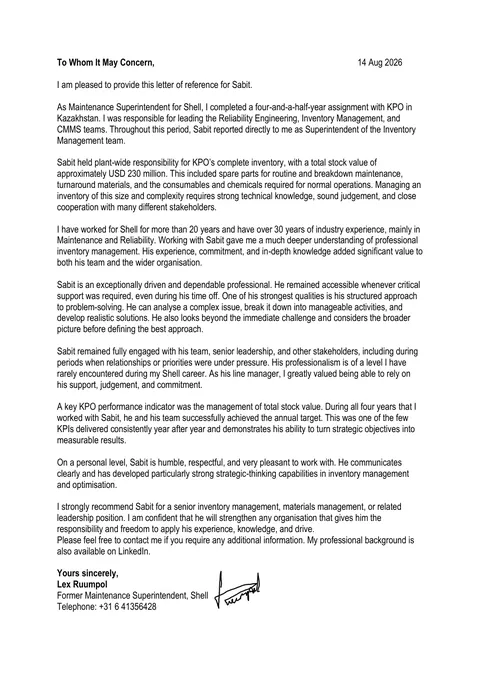
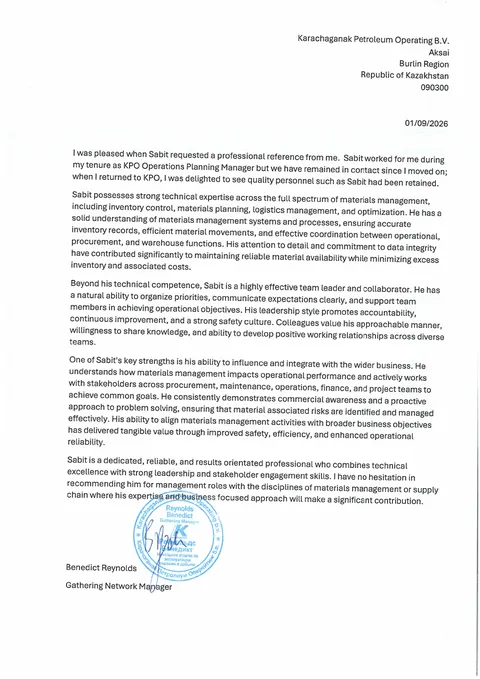
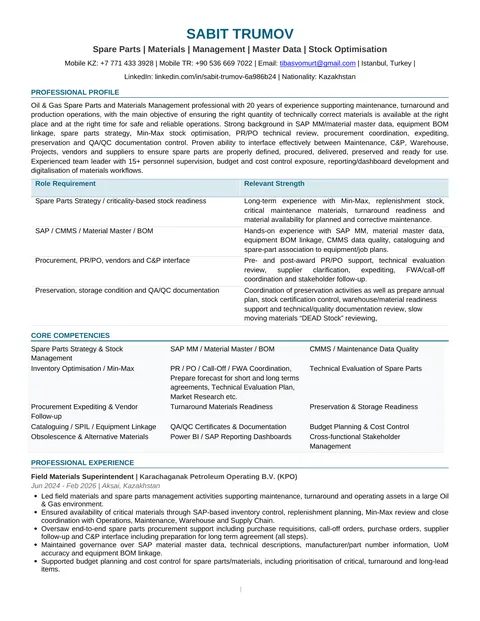
Basis of this case
CV: order placement support (Spare Parts Engineer, 2008 to 2011) and procurement support (Field Materials Superintendent, 2024 to 2026). Functional coverage: pre- and post-award support, forecasting, expediting, issue resolution and C&P coordination. Commercial procurement ownership is not claimed.

Connected intelligence
Where this case connects to the career, the Knowledge Book and the credentials.