Case 07Digital product concept
Material Urgency Workflow
Business questionHow can urgent material requests move quickly without losing ownership and traceability?
End users, coordinators, responsible engineers, warehouse and procurement in one visible urgency process with an owner at every step.
A digital concept developed from operational experience. It is not presented as a deployed corporate system.
Why it matters
- AvailabilityGenuine emergencies get material faster.
- AccountabilityEvery step has a visible owner.
- TraceabilityJustification and actions are recorded.
- GovernanceUrgent stays an exception, not a shortcut.
01Business context
Urgent material requests are where normal process and real operational pressure collide. A failed component, an unplanned job or a turnaround finding needs material now, and the request often travels by phone, email and personal contacts.
That speed comes at a price. Nobody can see where the request is, several people work on it at once, the justification is never recorded, and urgent becomes the normal way to get attention.
This concept designs one visible workflow for urgent requests: justified at the start, assigned to an owner, accepted by each function that has to act, and closed with a recorded resolution.
02My role
My contribution
I designed this workflow concept from operational experience with urgent maintenance demand: roles, steps, ownership and status visibility. It is presented as a digital product concept, not as a deployed corporate system.
Wider process
In practice an urgent request involves the end user, a coordinator, the responsible engineer, the warehouse and, when stock is not available, procurement and other dependencies. The concept describes how they could work in one shared flow.
03Signals and inputs
The information that drives the decision.
- S01Operational impactWhat stops or is at risk without the material.
- S02Need date and timeWhen the material must be available.
- S03Work orderThe job behind the request.
- S04Stock availabilityWhether the warehouse can issue immediately.
- S05Responsible engineerWho owns the technical side.
- S06DependenciesProcurement, transport or other functions needed.
04Workflow concept
How can urgent material requests move quickly without losing ownership and traceability?
- Check
- Gate: can trigger escalation
- Decision
Open a step to see why it matters and when it is escalated.
01End user
Request
Material, quantity, location and need time.
Why it matters
- Why it matters
- One entry point replaces scattered calls and emails.
02GateEnd user
Justification
Operational impact and work order.
Why it matters and when to escalate
- Why it matters
- Urgency needs a reason that others can see.
- Escalate when
- No justification is given.
03GateCoordinator
Assignment
Owner assigned and priority confirmed.
Why it matters and when to escalate
- Why it matters
- Someone is responsible from the first minute.
- Escalate when
- No owner within the agreed time.
04GateResponsible engineer
Acceptance
The technical owner accepts the request.
Why it matters and when to escalate
- Why it matters
- The engineer confirms it is the right material.
- Escalate when
- The request is technically unclear.
05GateWarehouse
Action
Stock issued or picking started.
Why it matters and when to escalate
- Why it matters
- Available stock should move first.
- Escalate when
- Stock is not available.
06GateProcurement / dependencies
Dependency
Purchase, transfer or transport arranged.
Why it matters and when to escalate
- Why it matters
- External steps get their own owners and dates.
- Escalate when
- A dependency blocks the resolution.
07DecisionCoordinator
Resolution
Material delivered and request closed.
Why it matters
- Why it matters
- Closure records what happened and why.
05Professional judgement
Urgency should be justified, owned and visible, or it stops meaning anything.
When every request is urgent, none of them is. The concept does not slow genuine emergencies down. It protects them from being buried under requests that are urgent only because the normal process was not trusted.
The design choice is to make justification one short step at the start rather than an approval chain. Speed and control are not opposites when ownership is clear from the first minute.
06What can go wrong
Urgency without justification
Routine demand takes the emergency route.
ControlAsk for impact and work order at the start.
No single owner
Several people chase the same request.
ControlAssign a coordinator at entry.
Invisible status
Requesters escalate through personal contacts.
ControlShow status to everyone involved.
Dependency without an owner
A purchase or transport waits for someone to act.
ControlGive each dependency an owner and a date.
No closure record
The same emergency repeats without learning.
ControlClose with a recorded resolution.
07Decision outcomes
- Issue from stockMaterial available and issued.
- TransferMaterial moved from another location.
- Emergency purchaseBought through procurement, with justification.
- Re-planWork rescheduled when material cannot arrive in time.
- Return to normal processThe request is not urgent.
08Intended value
- Faster genuine emergenciesReal urgency is not lost among routine requests.
- Visible ownershipEveryone sees who acts now.
- Recorded justificationUrgent requests can be reviewed and learned from.
- Fewer parallel effortsOne request, one flow, one owner.
09Evidence and basis
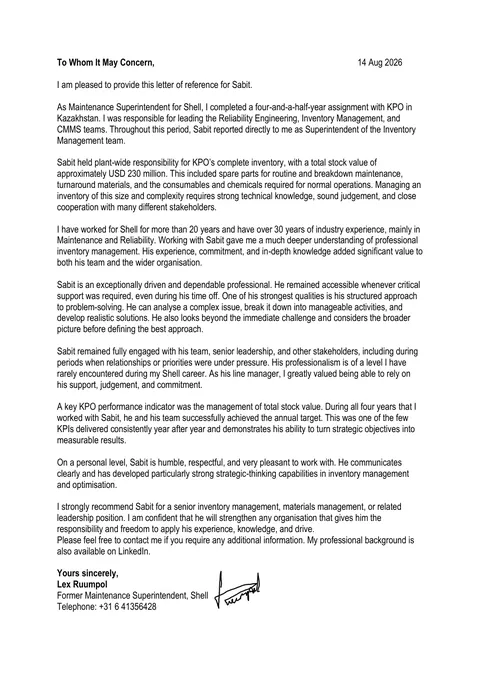
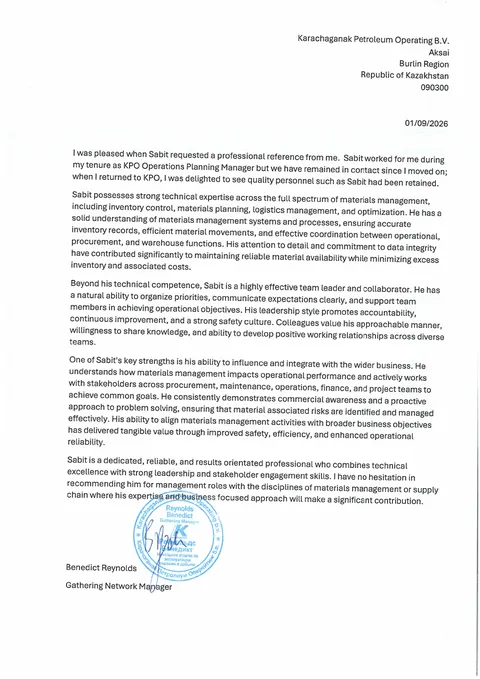
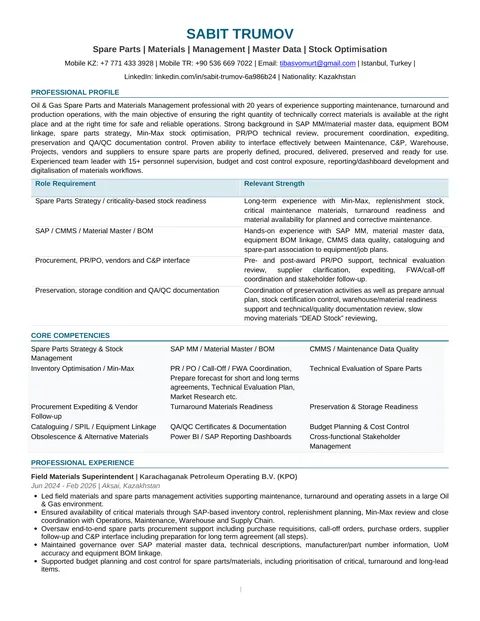
Related operational work: the letter mentions reviewing and optimising the material request process across KPO, described as achieved with Sabit's significant contribution. This concept is not presented as that process or as a deployed system.
SourceReference letter, Claudio Damanti, former line manager at KPO (2017 to 2023)
Basis of this case
Designed from operational experience with maintenance and turnaround material demand. Digital product concept: not presented as a deployed corporate system, and no adoption or results are claimed.
Connected intelligence
Where this case connects to the career, the Knowledge Book and the credentials.